


Skip to content
  • Products
    • Product Offering
    • Products
      • XEBEC Brush™ Surface
      • XEBEC Brush™ Surface Extra-Large
      • XEBEC Brush™ End Type
      • XEBEC Brush™ Wheel Type
      • XEBEC Brush™ Crosshole
      • XEBEC Back Burr Cutter & Deburring Path™
      • XEBEC Stone™ Flexible Shaft
      • XEBEC Stone™ Mounted Point
      • XEBEC Floating Holder™
      • XEBEC Brush Length Adjustment Tool™
      • XEBEC Ceramic Stone™
      • XEBEC Mobile Micromotor
      • XEBEC Burrless Chamfering Cutter
    • Application Guide
    • Tech Tips
  • Applications
    • Successful Applications
    • Industry Guides & Case Studies
    • Aerospace
    • Medical
    • Energy
  • Cost
    • Cost
    • Check Availability
  • Learning Center
    • Learning Center Blog
    • Virtual Booth
    • Technical
    • The Xebec Difference
    • Video
    • Literature
    • How to Choose a Deburring Method
    • Tech Tips
    • Specs
    • Applications
      • Trends to Embrace for the Future of the CNC Machining Industry
  • Contact
    • Contact Us
    • Meet Our Team
  • Products
    • Product Offering
    • Products
      • XEBEC Brush™ Surface
      • XEBEC Brush™ Surface Extra-Large
      • XEBEC Brush™ End Type
      • XEBEC Brush™ Wheel Type
      • XEBEC Brush™ Crosshole
      • XEBEC Back Burr Cutter & Deburring Path™
      • XEBEC Stone™ Flexible Shaft
      • XEBEC Stone™ Mounted Point
      • XEBEC Floating Holder™
      • XEBEC Brush Length Adjustment Tool™
      • XEBEC Ceramic Stone™
      • XEBEC Mobile Micromotor
      • XEBEC Burrless Chamfering Cutter
    • Application Guide
    • Tech Tips
  • Applications
    • Successful Applications
    • Industry Guides & Case Studies
    • Aerospace
    • Medical
    • Energy
  • Cost
    • Cost
    • Check Availability
  • Learning Center
    • Learning Center Blog
    • Virtual Booth
    • Technical
    • The Xebec Difference
    • Video
    • Literature
    • How to Choose a Deburring Method
    • Tech Tips
    • Specs
    • Applications
      • Trends to Embrace for the Future of the CNC Machining Industry
  • Contact
    • Contact Us
    • Meet Our Team

Deburring and Finishing Without Losing Tolerance in Aerospace CNC Machining

  • Home
  • Success Stories
  • Deburring and Finishing Without Losing Tolerance in Aerospace CNC Machining
  • Picture of Matt Seibert Matt Seibert
  • January 26, 2026
  • No Comments

In aerospace manufacturing, deburring and finishing can be difficult problems to solve.
The challenge is removing burrs without changing the part dimensions.

As tolerances tighten and part complexity increases, finishing becomes less forgiving. A few tenths of unintended material removal can affect fit, seal integrity, or inspection results. This is why deburring is often treated cautiously—or pushed to the very end of the process—despite the risk that introduces.

Understanding how burrs form, and how different finishing methods interact with geometry, is critical to designing a process that removes unwanted material without compromising what matters.


Why Tolerance Loss Happens During Deburring and Finishing

Most tolerance issues are not caused by aggressive material removal. They come from lack of control.

Common contributors include:

  • Manual pressure variation
  • Tool stiffness that transfers force directly into the part
  • Uncontrolled contact angles
  • Repeated handling outside the machine

In practice, this often shows up as:

  • Loss of flatness or parallelism
  • Rounded edges where sharp edges are required
  • Dimensional drift at mating surfaces
  • Inconsistent inspection results across shifts

The more a process relies on operator technique rather than programmed behavior, the harder it becomes to predict the outcome.


Removal of Surface Peaks — Not Geometry

A key distinction in aerospace finishing is understanding what should be removed and what should not.

Peaks are localized material formed during machining. They are not part of the intended geometry, but they often sit directly on functional edges and surfaces. Removing those peaks without affecting the surrounding material requires a finishing method that is compliant, not rigid.

Rigid tools tend to:

  • Transfer force directly into the part
  • Follow geometry rather than selectively removing peaks
  • Increase the risk of dimensional change

Compliant finishing tools, when properly applied, behave differently. They contact high points first and deflect before significant force is transferred into the underlying geometry. This makes it possible to remove peaks while preserving edge position, surface flatness, and critical dimensions.


Flatness and Parallelism: Where Things Go Wrong

Flatness and parallelism issues do not always originate during roughing or finishing passes. In many aerospace parts, achieving these specifications during initial machining is already difficult, especially as tolerances tighten and geometries become more complex.
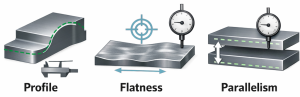
 

Because those requirements are often only just met coming out of machining, finishing and deburring operations become a critical risk point. Even small, unintentional forces applied during secondary operations can push a feature out of specification. Hand deburring is a common source of this risk. Light, localized pressure can distort thin sections or subtly alter reference surfaces in ways that are not immediately visible, but often appear during inspection—or later, during assembly.

For high-tolerance aerospace components, finishing methods must:

  • Apply consistent, controlled force
  • Avoid concentrating pressure in a single area
  • Be repeatable from part to part

Any process that lacks this level of control increases the likelihood of losing flatness or parallelism, regardless of how carefully it is performed.


Removing Burrs Without “Breaking” the Edge

Not all aerospace edges should be rounded. In many cases, edges are specified to remain sharp, with only minimal burr removal allowed.

This is where uncontrolled deburring causes problems. Traditional approaches often remove material indiscriminately, turning burr removal into unintended edge modification.

Controlled brushing processes allow manufacturers to:

  • Remove burrs while maintaining edge location
  • Apply a consistent, predictable edge break when required
  • Preserve sharp edges where specified
  • Avoid over-processing sensitive features

The goal is to preserve the part while removing what does not belong.


Keeping Finishing Inside the CNC

One of the most effective ways to protect tolerances is to keep deburring and finishing inside the CNC process.

In-machine finishing offers several advantages:

  • Tool paths are programmed and repeatable
  • Contact force is consistent
  • Part orientation is controlled
  • Handling is minimized
  • Results are predictable across machines and shifts

When finishing becomes just another programmed operation, it stops being a variable and starts being part of the process design.


Designing for Predictability, Not Correction

In aerospace manufacturing, finishing should not be a corrective step. It should be a controlled operation designed into the process from the beginning.

Processes that rely on manual intervention to “fix” burrs or edges introduce uncertainty late in production—exactly where risk is highest.

By selecting finishing methods that remove peaks without altering geometry, manufacturers can:

  • Maintain tight tolerances
  • Protect flatness and parallelism
  • Reduce inspection failures
  • Eliminate late-stage surprises

Deburring does not have to be a compromise. When it is controlled, compliant, and repeatable, it becomes just another predictable part of a high-quality aerospace machining process.



We Can Help Eliminate Late-Stage Risks

Our Application Specialists can help identify a controllable and consistent finishing solution for your processes. Reach out to us to get started.

  • Industry: Aerospace
  • Category: Success Stories, Xebec Advantage

Share:

  • https://deburringtechnologies.com/deburring-and-finishing-without-losing-tolerance-in-aerospace-cnc-machining/
Picture of Matt Seibert

Matt Seibert

Get updates in your inbox

Related Content

Blurred Motion Shot of a Team of Engineers, Professionals and Workers, Working on Assembly and Production Line, Optimizing CNC Machinery, Programming Machines.
Trends to Embrace for the Future of the CNC Machining Industry
Job Costing for CNC Machining Centers: Challenges and Opportunities
CNC vs. Robot: Which is Best for Your Deburring and Finishing Jobs?

Leave a Comment Cancel Reply

Your email address will not be published. Required fields are marked *

Get updates in your inbox

Cutting fiber brushes and stones are cutting tools and are often rotated at high speeds with a power tool or in a machine tool. They should never be operated at higher than the maximum speeds listed. When using these tools, safety glasses and gloves should be worn. Breathing the dust created by using these products for prolonged periods of time should be avoided.

Operations Center:

8241 Expansion Way
Dayton, OH 45424

Technical Support: 1 (800) 434-9775

Toll Free: 1 (800) 306-5901

[email protected]

www.deburringtechnologies.com

Connect with us on
LinkedIn

Subscribe to our
YouTube Channel

Copyright 2026 | XEBEC© Deburring Technologies | All Rights Reserved.
  • Terms
  • Privacy Policy
  • Cookie Policy

Discuss an Application

Please provide us with details regarding your application and a team member will contact you within one business day. Or, our team is available Monday-Friday, 8am – 5pm EST via telephone (800) 306-5901 to discuss your application.

 
This field is for validation purposes and should be left unchanged.
Name
Address
Industry
What is your primary industry?

What is the part material/hardness? (Space provided for multiple entries, if applicable)
What is the current process or tools being used?
(Space provided for multiple entries, if applicable)
What is the step or tool used prior to deburring? (Space provided for multiple entries, is applicable)
What is the finish requirement? (Space provided for multiple entries, is applicable)
What is the machine type? (Space provided for multiple entries, is applicable)
Please provide the machine's max RPM. (Space provided for multiple entries, is applicable)
Coolant Capability
What is the burr size/thickness? (Space provided for multiple entries, is applicable)
Please help us to understand the reason(s) for seeking an alternative deburring method.
Would you like a copy of your responses?

Contact Us

Thank you for visiting the virtual booth of Xebec Deburring Technologies. Please provide contact information below.

Name(Required)
Preferred Method of Communication
Please feel free to include any notes about your company, current application, specific product interest, etc.
Would you like a copy of your responses?