
How Engraflexx turns “scrap risk” into a repeatable, salvageable process
Every CNC application engineer knows the moment.
The simulation was perfect.
The toolpaths were clean.
The part comes off the machine… and the edge isn’t where the model said it would be.
Not by much.
A little mismatch between the machined surface and the raw casting.
A weld seam that wandered.
A flame-cut profile that moved just enough to ruin your beautiful chamfer path.
Now you’re standing there with three bad options:
Hand it to an operator with a die grinder and hope for consistency
Write a complex, part-specific deburring routine that still won’t hit every variation
Or worse — call it scrap
This is exactly the problem Gravostar designed Engraflexx to solve.
The reality of “undefined edges”
In real production, edges are rarely perfect:
Castings shift
Forgings grow and shrink
Weldments distort
Raw stock isn’t consistent
Re-clamping introduces positional variation
So the programmed contour and the actual edge don’t match.
Traditional deburring tools require the edge to be exactly where the CAM system thinks it is.
Engraflexx flips that relationship.
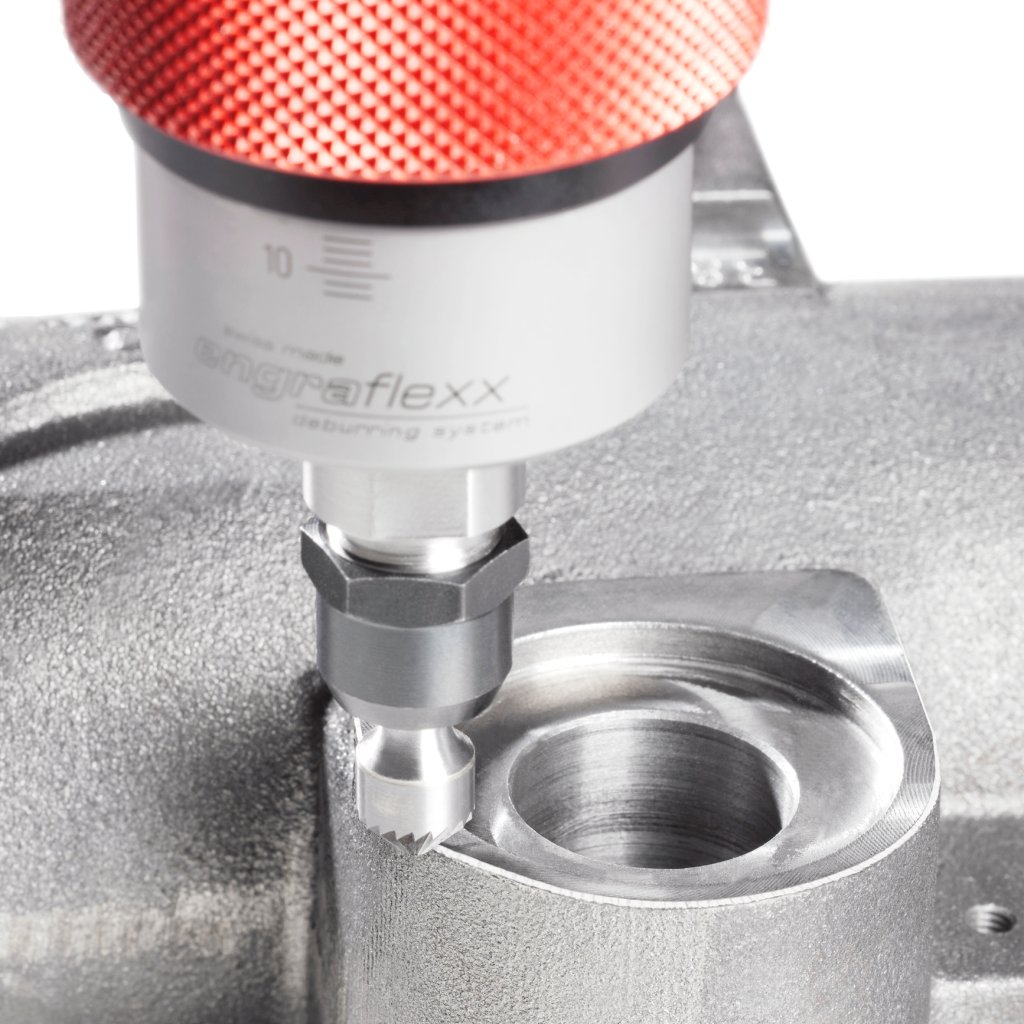
Instead of forcing the program to chase the part, the tool mechanically follows the real edge using a spring-preloaded, deflecting spindle that maintains constant contact pressure.
The result is simple but powerful:
Uniform chamfers — even when the geometry isn’t uniform.
Salvaging parts instead of babysitting processes
For an application engineer, this isn’t just about deburring.
It’s about what happens when:
The casting stock varies from batch to batch
A supplier sends a “slightly different” revision
A weldment moves during stress relief
The burr size isn’t consistent
With a rigid toolpath, every one of those becomes a programming problem.
With Engraflexx:
The tool automatically compensates for dimensional and positional variation
Every part is deburred evenly
No contour-perfect programming required
That means parts that used to require manual rework — or got scrapped — can now run through the machine and come out finished.
One less fire to put out on the shop floor
Most engineers aren’t fighting deburring itself.
They’re fighting the side effects:
Operators tied up at a secondary station
Machines waiting for parts to come back from manual cleanup
Inconsistent edge quality between shifts
Missed features that show up at inspection
Manual deburring is expensive, noisy, dirty, and dependent on individual skill — and even the best people make occasional mistakes.
Integrating deburring into the CNC cycle means:
Parts leave the machine complete
No forgotten edges
No extra handling
No separate scheduling
No re-clamping variation
For a production engineer, that’s not a tooling improvement.
That’s process stability.
The human side: pressure, not just productivity
There’s also the part nobody puts in the cycle-time calculation:
The operator standing next to a machine,
with a hand grinder,
trying not to damage a sealing surface.
Manual deburring adds:
Noise
Dirt
Injury risk
Time pressure between machine cycles
Automating that step doesn’t just save time.
It removes one of the least repeatable, least motivating jobs on the floor.
And it lets skilled people focus on work that actually needs skill.
Why this matters in high-mix, real-world production
Engraflexx shines where:
Part variation is normal
Programming time matters
Throughput depends on flow, not just cutting time
“Close enough” edges still need to look perfect
Because the tool maintains a constant force against the real edge, the chamfer becomes:
Dimensionally consistent
Visually uniform
Independent of burr thickness or edge position
So the result is predictable — even when the input isn’t.
More than deburring: controlled rework inside the cycle
This same mechanical compliance allows you to:
Knock down casting mismatch
Remove weld seam high spots
Level parting lines
Blend transitions
Improve surface condition
All without turning rework into a separate operation.
That’s where the real ROI lives.
What this means for the application engineer
At the CAM desk, Engraflexx changes the conversation from:
“How do I program for every possible variation?”
to:
“How do I let the process absorb variation automatically?”
It reduces:
Programming complexity
Setup sensitivity
Operator dependency
Scrap risk
And it increases:
First-pass yield
Flow through the shop
Confidence in unattended or lights-out runs
The real advantage isn’t the tool — it’s the outcome
Because at the end of the day, the goal isn’t a better deburring method.
It’s this:
A part that comes out of the machine
finished, consistent, and ready for the next operation —
even when the edge tried to ruin your day.
Engraflexx doesn’t make your parts perfect.
It makes your process resilient to the fact that they aren’t.
Learn more about Engraflexx Deburring Tool Holders
Lorem ipsum dolor sit amet, consectetur adipiscing elit. Ut elit tellus, luctus nec ullamcorper mattis, pulvinar dapibus leo.